
Niche Interests
Thoughts about the internet, scarcity, and my own quirks of personality

When something is part of our life over a long period, and our relationship to it shifts it can be hard to tell, how much of what we see represents our own changes. I’ve read a couple of pieces about the frustrations of the online experience, and it has prompted me to reflect on my own experiences and the way in which my expectations have changed over time.
I’m in my late 40s, I’m near to the end of the generation who first had access to the internet when they went to college. Throughout my adult life I have read and participated in online communities and been interested in the idea of online life; often with a nostalgic bent. I was attracted to the idea of electronic communities well before I was part of one myself. I have never been “extremely online” in the sense of having my pop culture references come from the internet; I tend towards niche interests, for reasons that reflect quirks of my personality.
Some people enjoy the feeling of being at the center — of attention or of action — and that can be exciting and often competitive. People enjoy feeling like they are involved in something that other people are outside of and wanting to get in. I, by contrast, would much rather be off on the edge. I’m not drawn to attention, and and I feel self-conscious when I’m concerned that I’m taking someone else’s spot.
A friend in college described me as “competitive but not ambitious” which captures something about my spirit. I enjoy being good at things, and competing as a way of being immersed in the activity of skill and effort. But I don’t look for competition to set me apart, or put me ahead of other people.
Part of the appeal of the early internet was that it felt like the infinite depth of cyberspace allowed people to find their own niche without displacing others. John Locke famously wrote that it was appropriate for people to take resources from the common for their own use when there was, “still enough and as good left, and more than the yet unprovided could use.” In an increasingly populated world, there are fewer circumstances in which those conditions appear to be met, but in the online world it was easy to believe that was the case.
That was what I was attracted to, and I found it online. It reflects that spirit that the first online forum in which had the feeling of being astonished that such rich discussion was freely available was reading the newsgroup rec.games.advocacy in the late 90s. I was interested in role playing games as a teenager and it was remarkable to find an incredibly rich discussion of what makes RPGs work. I also recognize, looking back, that it was deeply niche. The FAQ for the newsgroup mentions that the conversation grew out of a group that was originally started as a way to segregate discussions that were annoying other people.
The forum rec.games.frp.advocacy is a Usenet newsgroup for discussing comparisons between different role-playing games (RPGs) and RPG styles. It was started in May 1992 as an offshoot of the group rec.games.frp.misc. The original intent was for it to be a place for heated arguments ("flame wars") between advocates of different games. However, in the process of hashing out differences, a set of contributors began to actually discuss core concepts of role-playing: what it is, how it works, what styles and techniques exist, how to do it better.
I believe that the key development of the group was an acknowledgement that there are different valid styles of role-playing. Different role-playing games are not merely different methods to achieve the same goals, but actually different goals in themselves. It pushed past differences to allow at least some discussion between gamers of very different styles of play.
In my memory there were 20-30 regular posters of which, 5-10 were most active. I never posted, I don’t know how many other people lurked, but it never looked like the participants were seeking an audience; they were happy to have an interesting group to hash things out with.
Similarly, when I’ve found blogs that I end up regularly reading and (sometimes) commenting, they are larger than that, but tend to grow to medium-sized blogs and then plateau because they have found what they want to be.
The development of the internet has tended to move away from that as a default, in significant part because of the way things are monetized. In the 90s there was a strong ethos of a noncommercial internet, and that has given way to a expectation that both creators and platforms can and will earn a lot of money online, and that shapes the context for most online activity.
One consequence of that, is that it reduces the sense of an abundant commons that I started with. The ability to make money creates scarcity, because some there are better and worse positions from which to make money.
Internet users have now seen several cycles of some new platform opening up, people using it because it’s fun and interesting, and then having a strong first mover advantage in being able to attract followers that later users have to work much harder to catch up. It creates a question of, “am I exploiting the platform, or is the platform exploiting me” that I don’t remember from usenet.
But, I also realize, that the portrait I have drawn is incomplete. I started by saying that I was able to find what I was looking for. But there have also been people interested in using the internet for self-promotion, to build an audience, or make money, from early on, and they weren’t wrong. A purely non-commercial internet wouldn’t be as rich and vibrant.
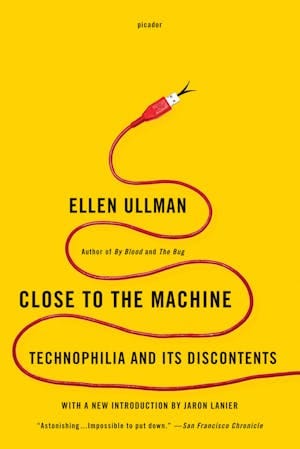
The book I’m holding in my profile picture is Ellen Ullman’s Close To The Machine with the subtitle, “Technophilia and Its Discontents.” It’s remarkable how much, 25 years later, both halves of that still speak to me. Her memoir captures the pleasure of being an early professional programmer and being able to experiment and make things work, and also concerns about the ways in which money shapes what gets built and what that does to the culture.
I am curious to hear from readers how much of what I’m saying resonates with other people’s experience, but I offer a final thought on Substack. I think Substack is trying to have it’s cake and eat it too — building a space which can support both commercial and non-commercial uses and host authors who are enjoy a niche, and other who want rapid growth. I think it’s tough to serve both of those equally, but I appreciate the artempt.
Writing this post I find myself thinking different about something that Mills, 𝔄𝔯𝔠𝔥𝔢𝔱𝔯𝔬𝔫𝔢𝔰𝔰 𝔬𝔣 𝔒𝔟𝔩𝔞𝔩𝔦𝔞 , wrote.
Almost all producers want platforms to do a ton of exploration: show readers lots of options! Show them lots of stuff! Show them my stuff, even if they’ve never read anything like it; they might love it! (And they might; this happens daily).
But almost all consumers —regardless of what they say— punish exploration. You’ve had this experience yourself, almost certainly: sitting at the restaurant you visited for a burger, the waiter makes you listen to the specials, even though you know you don’t want them, for example; or loading YouTube and seeing a ton of videos you wouldn’t watch in a million years; or whatever.
I would suggest that one reason why readers punish exploration is that it takes away from them the ability to chose, “what space am I in.” In the 90s exploration was done by hyperlink; you would start from a spot and could decide, “how far do I want to explore.” Sometimes you might be searching for depth, looking for more information on the same topic, sometimes enjoying the strangeness of following a few links and ending up absorbed in something completely different than where you started.
But a hyperlink always creates a context, “I am coming from X, going to Y, using a link created for reason Z and I can always return to X.” Having a platform recommend something takes away that context and is a reminder that whatever mental context people use, as readers or writers, to place themselves, from the point of view of the platform everybody is in the same space, which is an imposition.
I wouldn’t have been able to say that so clearly, without writing this piece, but I have a great deal of fondness for the possibilities of what can happen in weird little corners.
Hi Nick, I have been reading a lot on this subject of late and it's not all driven by algorithms as much of it has been in good old-fashioned print. And I think you hit on something here without saying it, that "exploration" (the hyperlink usually connected to specific words in a sentence - i.e., here's the referenced article/video/music/Wiki - has been replaced by "algorithm." It's highly damaging to creativity and curiosity. It's all damaging to our younger generations; I have seen my own children go down far too many damaging rabbit holes that have been difficult to get back out of. Internet v.1 didn't care about numbers/followers, the "likes" had not been "invented" and YouTube hadn't been created. Internet v.2 was all about profiting from the new medium - and at the expense of humanity. Here's to those of us wh are at least aware of some of this. Cheers, tony
This piece really resonated with me, even though I'm about a decade younger (or even a little more) than you. I grew up with the internet in the very early 2000s, when it was quite different from what you knew when you were coming of age. Then again, the internet of the 1990s and early 2000s probably has more in common with each another compared to how it started to look even in the early 2010s. I wonder when the inflection point was?